Collaboration
Welcome back bloggers to the last blog before the Christmas break. Today’s blog is going to discuss Collaboration. Throughout the blog, I am going to focus on what collaboration is, how it can be implemented, what are the positives of it and my own experience of collaboration in a teaching setting.
According to Donaldson (2016) collaboration is a key skill which is required by employers which is why schools should be required to demonstrate and teach collaboration. Within the classroom teachers need to plan in advance to ensure a collaborative environment is fostered.
According to Lloyd and Beard (1995) language is a huge factor when collaborating, it is essential when communicating. Individuals are able to interpret work when using language when collaborating with others. Similar to Lloyd and Beard, Barnes (1976) believes that communication is essential and it is at the heart of education.
When implementing collaboration, teachers communicate with learners but to ensure that the learner collaborates back through the use of language they need to talk about the learning experience. Teachers should ensure that a variety of opportunities are available for learners to collaborate with one another, using discussions in problem-solving, playground and talking in groups are useful activities to ignite collaboration. (Garvey, 1984)
The history of collaboration does not date back very far as it is a 21st century way of working. (Laal,2012) According to Leonard and Leonard (2001) within the working world as the 21st century began an emphasis shift occurred changing from individual efforts to individuals working as a team to complete tasks.
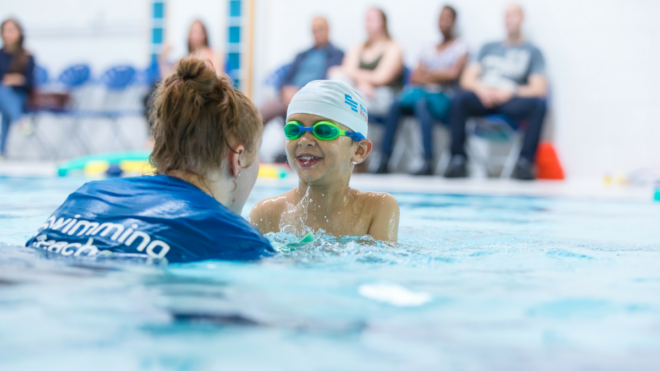
The experience I have had of a change from working as an individual to a team is as a swimming teacher. As a swimming teacher two years ago the consensus was to teach your stage and once they have completed the stage outcomes place them in the next stage with another teacher. The issue with this was that there was no communication between teachers to discuss what the swimmer may have needed to improve on or any special requirements they need. In the past year collaboration, has been a huge focus for Swim Wales, CPD sessions on collaboration have been implemented and working together as a team for the best interests of the swimmer has been successful.
Within the classroom, collaboration has had a huge influence on learners. The major change in classrooms is the layout, traditional rows of seats and tables have been scrapped for a more engaging layout of circle tables where learners sit around and have full input with those around them. (BBC, 2008)
This image represents a more modern classroom with circular tables in place to ensure collaboration between learners.
Although collaboration is only a modern way of working many theorists believed that collaboration was vital in personal development years ago. Piaget believed that peer interaction through collaboration plays a vital role in development. Similar to Piaget, Vygotsky (1978) noted that social interaction was vital for the learner’s development process.
Furthermore, Barnes and Todd (1976) argued that traditional teaching styles should be replaced new models of teaching which encourage critical thinking similar to real life situations where they would be challenged by opposing views but have to take other people’s viewpoints in to account to make a rational decision.
Another one of the many positives of collaboration is that learners are able to achieve a deeper understanding as they learn in small groups rather than working on their own. When learners work on their own they only have a small understanding but with others, this understanding becomes clearer. (Johnson and Johnson 1994)
At the start of the blog, Donaldson’s definition of collaboration was included, his beliefs on collaboration stemmed from Hattie’s research. Hattie (2009) researched over 50,000 students in over 800 meta-analyses. Hattie found that working collaboratively either on a competitive or cooperative level had more of an effect on learning than individual methods. Hattie also found that the feedback learners receive mostly comes from their peers so working collaboratively aids learners when making errors they can correct them easily. As Donaldson’s recommendations have been accepted by the Welsh Government Hattie’s research is extremely reliable as it’s a huge analysis and findings are being implemented by the government.
Collaboration can be implemented in three ways according to Reynolds (1994). The first being motivational, if a learner is enjoying their selves they are motivated to complete tasks. Learners can be motivated when taking part in games, activities use values, feelings and the mind which makes it easier for learners to remember their learning. The second way collaboration can be implemented is educational, as learners are working together they can learn off peers which are a daily social process they take in many other scenarios. The third and final way Reynold believes collaboration can be implemented is ideological, with ideas being collectively used in the classroom and being used in a democratic way, just like individuals would live and work within society.
Vygotsky’s zone of proximal development. Vygotsky created the idea of ZPD that the ZPD is the middle between a learner’s current achievement and the point which is beyond their reach at the current time. The point which is out of reach can be achieved by working with peers when problem-solving. Vygotsky’s idea believed that knowledge was built upon through social interaction with peers, teachers and the family. (Vygotsky, 1978)
In summary, collaboration is a growing trend throughout education with learners and practitioners working together to ensure learning takes place. In the modern day and progressing through to the future collaboration is not only going to be connected by other peers and teachers but also technology. Technology encourages mass collaboration with those around the world. Thank you for reading the blog, have a lovely Christmas and see you in the new year. Nadolig Llawen
Reference list:
Barnes, D. (1976) From Communication to curriculum. Harmondsworth: Penguin.
BBC (2008) Classroom Layout. Available at: https://www.teachingenglish.org.uk/article/classroom-layout (Accessed:30 November 2017).
Beard, J. and Lloyd, C. (1995) Managing classroom collaboration. London: Continuum International Publishing Group Ltd.
Bennett, D. and Todd, F. (1977) Communication and Learning in small groups. London: Routledge & Kegan Paul.
Donaldson, G.
(2015). Successful futures:
Independent review of curriculum and assessment arrangements in Wales. Welsh Government.
Garvey, C. (1984) Children’s Talk. London: Fontana.
Hattie, J (2008) Visible Learning. London: Routledge
Johnson, R. T., and Johnson, D. W. (1994). An overview of cooperative learning. In Thousand, J., Villa, A. & Nevin, A. (Eds.), Creativity and collaborative learning (p.2). Baltimore, Maryland; USA. Brookes Publishing.
Laal, M. (2012) 'Benefits of collaborative learning', Social and Behavioral Sciences, 31, pp. 486-490
https://www.pinterest.co.uk/pin/235242780505606160/ (2014) (Accessed: 30 Novemebr 2017).
Reynolds, C (2 ed.) (2003) Handbook of Psychological and Educational Assessment of Children . London: Guilford Press
Vygotsky, L. (1978). Mind in Society. Cambridge, MA: Harvard University Press.


Great blog Rhys! Found it very interesting to read, especially about your own experience. You have mentioned how working collaboratively with others promotes the best outcome for a child’s swimming lesson. However, in your opinion what are the main changes you have seen? As you mentioned it has been successful, why is this?
ReplyDeleteI also noticed how you mentioned round tables in the classroom. I think this is immensely important for children, as I have also highlighted in my own blog. Could you maybe expand on this, what are your thoughts on children working on round tables, does this make a difference in their learning? In my own blog I have mentioned how this promotes a child’s confidence as they are able to communicate, share ideas and have the use of eye contact, where Lenard and Lenard (2001) have agreed by commenting on how efforts has shifted to make room for group work in education. Do you agree with this?
Leonard and Leonard (2001) Achieving professional community in school: the administrator challenge, planning and changing, 36(1), pp.23-39.
Thank you for the great comment Chelsea!
ReplyDeleteTo begin the main changes I have seen is one the childrens progression and two the collaboration between staff. Children are able to get to know more than one teacher which helps them as the get older that different social siutations become easier and they are able to interact with different individuals easily at any age. The collaboration between teachers has proved successful as a teacher is struggling with a learner they are able to ask the previous teacher for any advice which they may have to resolve an issue.
As from my own experience working in round tables is of great importance as each individual has to provide an input in to classroom work, the main good thing is that not one individual is being picked on but the whole table so they can generate the best answer. I agree working in round tables improves a childs confidence as they work together they are able to learn off eachother and receive crucial impact from their own peers, this resembles teamwork within the workforce.
That must be great for the children being able to socialise with others, this will also improve their confidence and self-esteem for the future. I now see how collaboration enhances a successful outcome, as teachers communicating and sharing ideas can have a great influence on the child's needs. Thanks for sharing this with me Rhys.
ReplyDeleteGreat response, I totally agree with being able to answer a question as a table, which will generate the best answer. This will also give children the freedom to communicate and share ideas as a group instead of the whole classroom, which at times can be daunting for children.
ReplyDeleteHi Rhys, I really enjoyed reading your blog.
I agree that communication is a very important part of education as it can be argued that humankind is our greatest resource, we should utilise this.
It is nice to hear that your workplace identified an issue with the education provided and have taken the relevant steps to encourage collaboration, schools should work to do the same thing, which is so important as you’ve highlighted the views of well-known theorists such as Piaget and Vygotsky.
This was a lovely blog to read just before the holidays begin.